Guides · Health and personal care
What a bathroom scale actually measures
Weight it gets right. Everything else on the screen is a guess, and it helps to know how the guess is made.
Weight
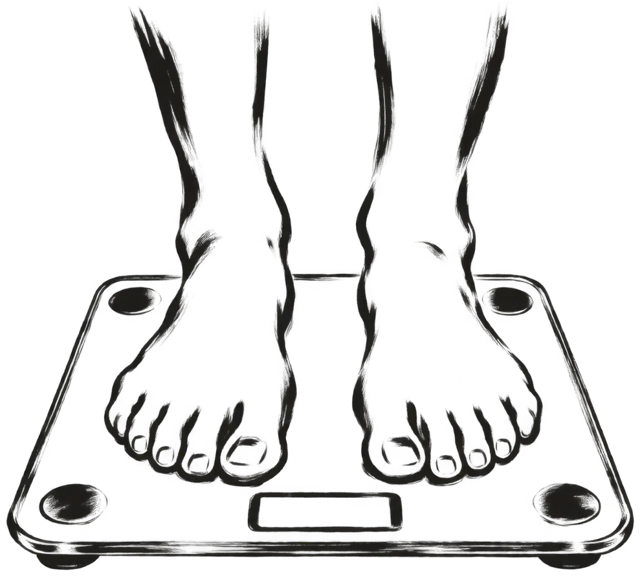
A modern scale measures how far tiny metal beams in its feet bend under you, using strain gauges stuck to them. It is accurate on a hard, level floor and usually wrong on carpet, because the feet sink and the beams flex differently. If the only place for it is a carpeted bathroom, a flat board underneath usually fixes most of the error.
Body fat
A scale that reports body fat passes a tiny current up one leg and down the other and measures how easily it travels. It is harmless for most people, but anyone with a pacemaker or another electronic implant, and anyone who is pregnant, should switch that feature off, which is what the makers say too. Fat resists the current more than muscle and water do. From that reading, plus the height, age and sex you typed in, an equation guesses your body fat. The guess moves with how much water you drank, whether you have exercised, and the time of day. It can be several percentage points out on any given morning. It is not useless, but it is a trend instrument, not a measurement.
Muscle mass, bone mass, water and the rest are derived from the same reading and the same details, so they inherit the same guesswork. Treat them as rough indications that move together.
How to get something useful from it
Weigh yourself at the same time of day, in the same state, on the same floor. Day-to-day changes are mostly water; over weeks the direction of travel is real, so look at the weekly average rather than any one reading.
Before you buy
Check the floor it will live on. Check that you can read the display from standing height. Ask whether you need the app to see your history, because a scale that keeps nothing without a phone is two things that can break.
More guides
- Network and Wi-Fi Where to put the router
The engineer left the socket in the cupboard. What to do about that, and when a second unit earns its money.
- Smart home Before you buy a smart plug
A lamp comes back on; a television just sits there. The guide sorts the house into those two piles, and asks one question about the broadband first.
- Audio and hearing What noise cancelling can and cannot do
The fridge disappears and the conversation stays. Why, and what that does for your hearing over the years.